
Jagannath
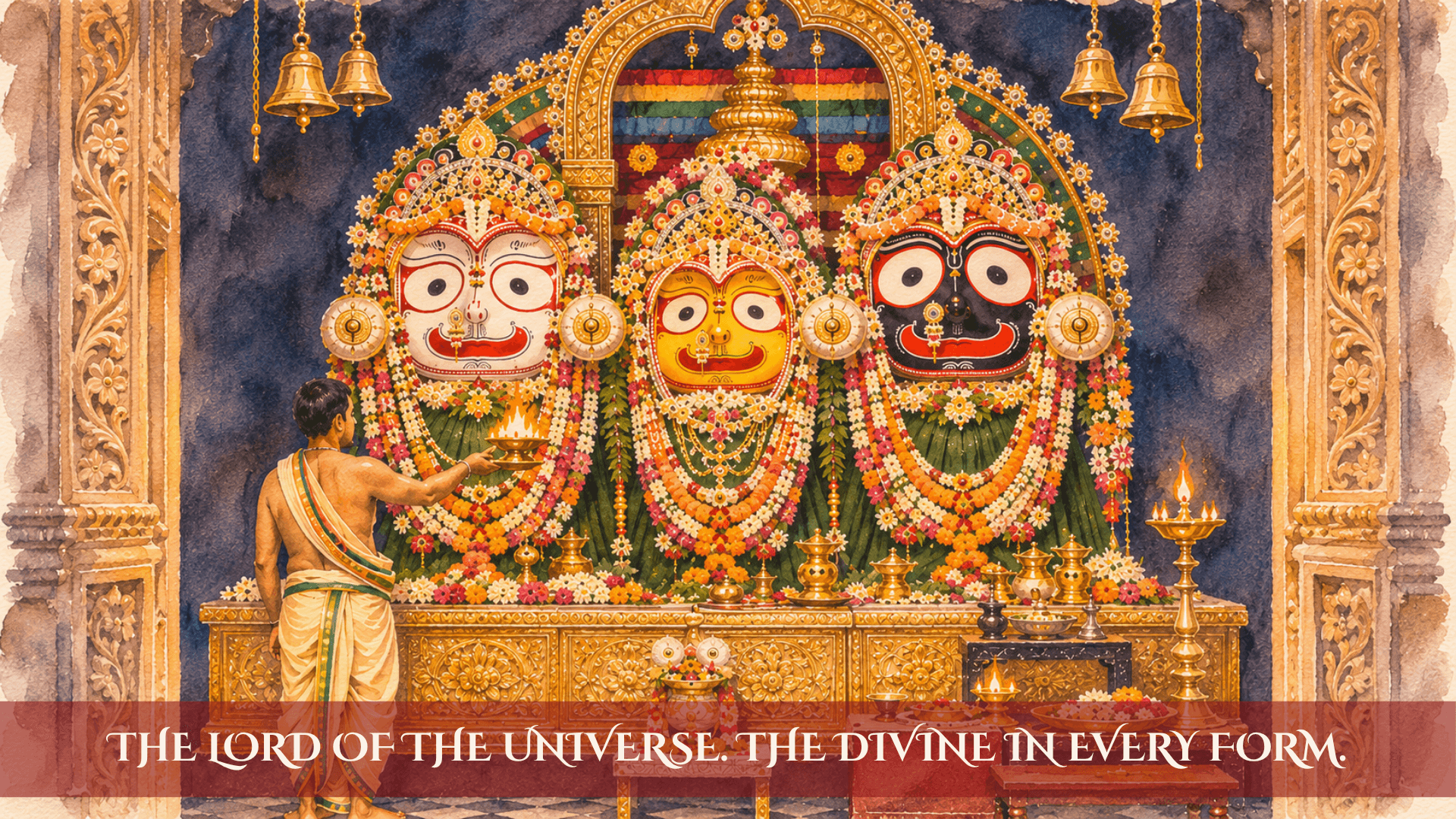
स्फुरत्पङ्केरुहाक्षं च चक्रहस्तं गदाधरम्।
कज्जलश्यामतनुं देवं जगन्नाथं भजाम्यहम्॥
– Traditional Puri Temple Prayer (Jagannath Dhyanam)
I meditate upon the supreme Lord of the Universe, whose form is as beautifully dark as black kohl, whose eyes are wide like blooming lotuses, holding the divine disc and mace in His hands.
Among the most revered deities in Hindu tradition, Jagannath is worshipped as Purushottam, the Supreme Being and the Lord of the Universe. His name comes from the Sanskrit words Jagat (universe) and Nath (Lord). Revered in Puri, Odisha, he is worshipped by many devotees as a manifestation of Krishna or Vishnu, embodying divine love, compassion and protection. According to the Skanda Purana, the story of Jagannath begins with King Indradyumna, a devoted ruler who heard of a mysterious deity named Nilamadhav, believed to be a form of Vishnu. Deeply moved by the accounts of his divine presence, the king set out in search of him. However, upon reaching the sacred shrine, he discovered that Nilamadhav had disappeared. Heartbroken, the king prayed for guidance. Lord Vishnu assured him that he would manifest once again in a sacred wooden form. Soon after, a divine log of wood was discovered by the seashore, believed to be Daru Brahma — the embodiment of the Supreme Being in wood.
According to the legend, a mysterious divine craftsman appeared to create the deities, asking not to be disturbed until his work was complete. When the king eventually opened the doors before the work was finished, the craftsman had disappeared, leaving behind the distinctive forms of Jagannath, Balabhadra and Subhadra. These sacred wooden idols became the centre of worship at the revered Jagannath Temple in Puri.
- The Divine Trinity – Jagannath is worshipped alongside his elder brother, Balabhadra, and his sister, Subhadra. Together, they form a divine trinity symbolising sacred bonds, protection and universal harmony.
- The Celebration of Rath Yatra – One of the grandest expressions of devotion to Jagannath is the annual Rath Yatra. During this celebration, the deities leave the temple on magnificent, decorated chariots and travel through the streets of Puri. This sacred procession symbolises the God stepping beyond the temple walls to meet his devotees, embracing people from all walks of life.
- The Beauty of the Formless Form – The distinctive appearance of the wooden idols carries a profound spiritual meaning. Their seemingly unfinished forms remind devotees that the Divine exists beyond human ideas of beauty and perfection. They represent the infinite taking a form through which people can experience and worship the Divine.
Today, Jagannath remains a symbol of universal love, compassion and inclusion. His story reminds us that divinity transcends appearances and boundaries, embracing all beings with equal grace.
Jagannath is the Lord of the Universe — infinite in essence, yet close to every heart. His form reminds us that the Divine is beyond perfection, and can be experienced through faith, love and surrender.