
Om
सर्वे वेदा यत्पदमामनन्ति तपांसि सर्वाणि च यद्वदन्ति।
यदिच्छन्तो ब्रह्मचर्यं चरन्ति तत्ते पदं सङ्ग्रहेण ब्रवीम्योमित्येतत्॥
– Katha Upanishad 1.2.15
That supreme goal proclaimed by the Vedas, sought through every discipline and every life of devoted enquiry. ‘I shall reveal to you in a single word: Om.
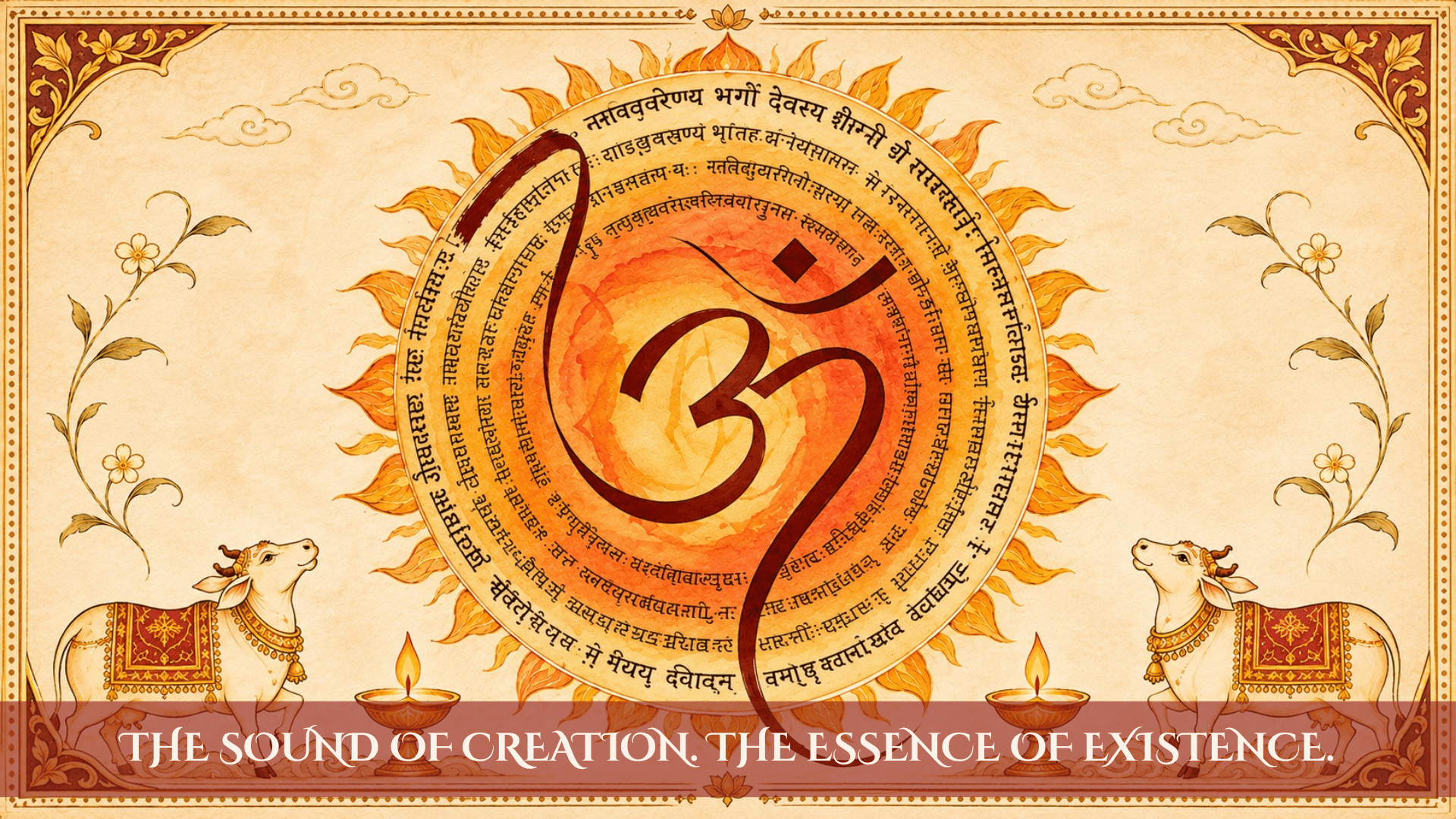
Among the most sacred symbols in Hindu philosophy, Om (ॐ), also known as Pranav, is regarded as the primordial sound of the universe and the essence of all existence. According to the Upanishads, Om represents Brahman — the ultimate reality that is eternal, infinite and beyond all forms. It is believed to encompass everything that was, everything that is and everything yet to come. The Mandukya Upanishad describes Om as the entirety of existence, revealing its profound connection to the universe and the consciousness within every being. Its three sounds — A, U and M — represent the three fundamental states of existence.
- A – Creation and the Waking State – The sound ‘A’ represents creation and the waking state of consciousness, where we experience the physical world through our senses. It signifies the beginning of existence and the emergence of life.
- U – Preservation and the Dream State – The sound ‘U’ represents preservation and the dream state, symbolising the continuation of existence and the inner world of thoughts, experiences and imagination.
- M – Dissolution and Deep Sleep – The sound ‘M’ represents dissolution and the state of deep sleep, where the external world and individual experiences retreat into stillness. It signifies the completion of the cosmic cycle and the return to the source.
Beyond these three sounds lies the silence that follows Om, representing Turiya — the fourth state of consciousness. It transcends waking, dreaming and deep sleep, symbolising pure awareness and the ultimate reality of Brahman. The Mandukya Upanishad further describes Om as a bow, the Atman (the individual Self) as an arrow, and Brahman as the ultimate target. Through meditation and spiritual understanding, the individual seeks to move beyond worldly limitations and realise their connection with the Divine. The Bhagavad Gita echoes this sacred significance through Lord Krishna’s declaration: “I am the syllable Om in all the Vedas.” Om is therefore more than a sacred sound or symbol. It represents the entire cosmic cycle of creation, preservation and dissolution, while reminding us of the eternal reality that exists beyond them.
Om is the sound from which all existence unfolds and the silence into which all existence returns — a timeless reminder that beyond the changing world lies one eternal truth.